AI Visibility
Hindi vs English: We Ran 690 Buyer Prompts. AI Recommended the Same Brands.
We expected Hindi prompts to surface different brands. Across 690 runs on three engines, they didn't — and the reason is the source graph, not the language.
Contents(8 sections)
Key takeaways
- Pallix ran 690 buyer prompts for 23 Indian health and nutrition brands across ChatGPT, Perplexity and Google AI, in both Hindi and English.
- Switching the query language produced no consistent uplift or downshift in any brand's visibility score. The same brands were named either way.
- The reason is the source graph: the engines resolved Hindi and English prompts to the same Indian aggregators, marketplaces and forums — Healthkart, Amazon.in, BigBasket, comparison blogs, Reddit.
- Hindi-only content is therefore not an independent lever for AI visibility. Presence on the sources AI already cites is.
- This is one category and one window. We list the limits plainly below, including where language could still matter.
We expected Hindi to change the answer. A large share of Indian commercial queries are not clean English. They are code-mixed — "kaunsa protein powder acha hai", "best supplement under 500 rupees ka" — and it seemed obvious that an engine answering in that register would reach for different sources and name different brands. Two of the earliest posts on this blog say exactly that.
So when we audited 23 Indian D2C health and nutrition brands in April and May 2026, we ran every brand's buyer prompts in both languages. The result is the finding we left out of the published India report because it did not fit the funding-versus-visibility story: query language did not change who got recommended.
This post is that finding, on its own, with the reasoning and the caveats.
What we tested
The study behind this post is the same one behind the May 2026 report. The design was simple enough to reproduce.
| Method | Detail |
|---|---|
| Brands audited | 23 Indian D2C health and nutrition brands |
| Prompts per brand | 30 buyer-intent prompts |
| Languages | English, and Hindi in the romanised form Indian buyers actually type |
| AI surfaces | ChatGPT, Perplexity, Google AI |
| Total executions | 690 prompt runs |
| Scoring | Share of prompts in which the brand appeared by name, scaled 0 to 100 |
| Period | April to May 2026 |
| Geography | India-specific prompts, sources and query origin |
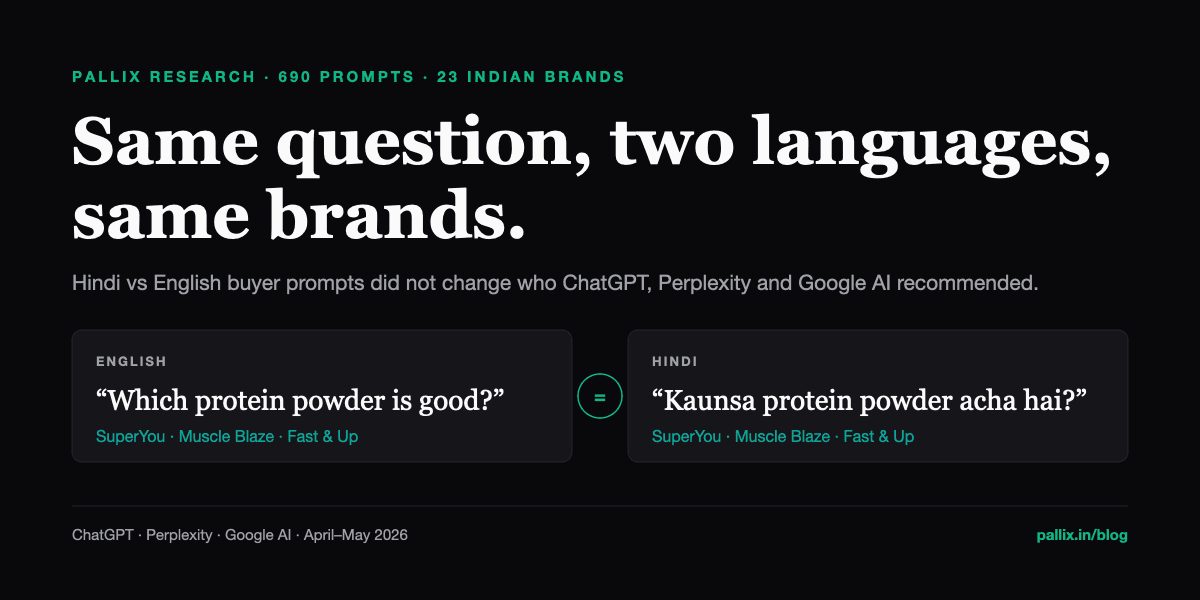
The prompts were decision prompts, not brand-name lookups: price ceilings, use cases, ingredient constraints, category comparisons. Each English prompt had a Hindi counterpart carrying the same intent. "Which protein powder is good?" ran alongside "kaunsa protein powder acha hai". "Best health supplement under Rs 500" ran alongside "best health supplement under 500 rupees ka".
What happened when the language changed
Nothing that survived scrutiny.
Across the 23 brands, the Hindi prompts produced broadly the same brand mention patterns as their English equivalents. The brands that led in English — SuperYou at 69 out of 100, Muscle Blaze at 67, Fast & Up at 65 — led in Hindi. The brands at the floor, six of them scoring below 30, stayed at the floor. There was no brand whose score moved consistently in one direction when the language flipped, and no engine where Hindi reliably favoured a different set of names.
The category average was 42.7 out of 100 and the spread ran from 24 to 69. That 45-point spread was explained by source presence, which we cover in the report. It was not explained by language, in either direction.
A brand that is invisible to "which whey protein is good" is invisible to "kaunsa whey protein acha hai". The language of the question does not rescue it, and it does not sink the brands that are already visible.
Why the language didn't move the score
The engines are not answering in Hindi from a Hindi corpus. They are resolving the intent of the prompt — protein powder, budget, good — and retrieving against the same set of sources they would use for the English version. In this category, those sources are overwhelmingly Indian aggregators and marketplaces written in English.
| Source cited | Share of source-traceable responses | What it contributed |
|---|---|---|
| Healthkart | 88% | Listings, editorial buying guides, expert comparisons |
| Amazon.in | 76% | Product pages, customer reviews, category rankings |
| BigBasket | 61% | Listings, category pages |
| Comparison blogs | 54% | "Best protein powder India" editorial |
| 48% | r/IndiaFitness and related recommendation threads | |
| Brand website (direct) | 22% | Mostly brands already above the authority threshold |
A Hindi prompt about protein powder still lands on Healthkart's buying guide, Amazon.in's category ranking and a Reddit thread. Those pages name the same brands regardless of how the question was phrased. The answer inherits that.
This is the same mechanism we see at scale in the India AI Sourcing Index, where competitor-owned sites and ranking pages account for roughly 58% of everything AI cites. What an engine reads determines what it says. Language sits downstream of that.
What this does not mean
We want to be precise about the size of this claim, because it is easy to over-read.
- It is one category. Health and nutrition in India has a dense, English-language, list-shaped source ecosystem. Categories with a genuinely vernacular content layer — regional food, ayurveda, agri inputs, wedding wear — may behave differently, and we have not tested them yet.
- It is romanised Hindi, not Devanagari. The prompts were written the way buyers type into a chat box. Native-script prompts may retrieve differently, especially on Google AI.
- It is about which brands, not how the answer reads. Framing, tone and the order of recommendations can differ between languages even when the set of names does not. We scored presence, not position.
- It is a window. April to May 2026, three engines. Retrieval behaviour changes, and a result that held in one quarter is a baseline, not a law.
- It says nothing about Hindi-language sources that do not exist yet. If a category's Hindi content ecosystem grows to the point where engines retrieve from it, the answers could diverge. In health and nutrition today, that ecosystem is thin.
What we got wrong earlier
Our first posts on what AI visibility is and on AEO and GEO for Indian brands describe a "Hindi dimension" in which Hindi queries draw on different sources and surface different competitors. That was a reasonable hypothesis in early 2026 and it is still worth measuring. In the one category where we have now measured it properly, it did not hold. We would rather publish the correction than let the assumption stand.
The refined position is this: run buyer prompts in both languages because that is how your buyers ask, not because the Hindi run will show you a different market. When the two runs diverge, that is a signal worth investigating. In our data so far, they mostly do not.
What Indian brands should do with this
- Stop treating Hindi content as an AI visibility lever on its own. Publishing Hindi versions of your pages does not change what the engines retrieve when the sources they trust are English-language aggregators. Do it for buyers who read Hindi, not for the score.
- Win the sources that answer both languages. In this category that meant Healthkart editorial, Amazon.in review depth, BigBasket listings, multiple independent comparison articles and organic Reddit presence. The top three brands were on all of them.
- Keep the Hindi prompts in your tracking set anyway. Not because they will surprise you this quarter, but because the day they start to diverge from English is the day a vernacular source layer has become load-bearing in your category, and you want to know first.
- Measure presence prompt by prompt. Even the leader in this study was absent from 31% of relevant prompts. The category is open, and the open ground is the same in either language.
Frequently asked questions
Does asking in Hindi change which brands ChatGPT recommends?
Not in the category we measured. Across 690 buyer prompts for 23 Indian health and nutrition brands on ChatGPT, Perplexity and Google AI, Hindi and English versions of the same prompt produced broadly the same brand mentions, with no consistent uplift or downshift for any brand.
Why do Hindi and English prompts return the same brands?
Because the engines resolve the prompt's intent and retrieve from the same sources either way. In Indian health and nutrition those sources are English-language aggregators, marketplaces and forums — Healthkart appeared in 88% of source-traceable responses, Amazon.in in 76%, BigBasket in 61%, Reddit in 48%. Those pages name the same brands regardless of the question's language.
Should Indian brands create Hindi content for AI visibility?
Create it for Hindi-reading buyers, not as a visibility tactic. The study found Hindi-only content does not independently improve AI visibility unless the sources the engines retrieve from also change. Presence on category aggregators, comparison articles and community threads moved scores; language of the prompt did not.
Does this apply to every category in India?
No. It was tested in health and nutrition, which has a dense English-language source ecosystem. Categories with a real vernacular content layer, such as regional food or ayurveda, may behave differently and have not yet been measured the same way.
Were the Hindi prompts in Devanagari script?
No. They were romanised, code-mixed Hindi, the way Indian buyers type into a chat interface: "kaunsa protein powder acha hai" rather than native script. Native-script prompts may retrieve differently and are a separate test.
Should I still track Hindi prompts for my brand?
Yes. Your buyers ask that way, and the moment Hindi and English results diverge in your category is a meaningful signal that a vernacular source layer has started to matter. Tracking both is how you see it early.
Where does this data come from?
From Pallix's April to May 2026 audit of 23 Indian D2C health and nutrition brands: 30 buyer-intent prompts per brand, 690 executions across ChatGPT, Perplexity and Google AI, scored as the share of prompts in which each brand was named. The brand-level findings are in the full India AI visibility report.
Cite this finding
Pallix, "Hindi vs English buyer prompts and AI visibility for Indian brands", September 2026. https://pallix.in/blog/hindi-vs-english-ai-visibility-india
To see how your own brand appears across ChatGPT, Perplexity and Google AI, in English and in the way your buyers actually ask, run the free AI visibility audit. To request the underlying data for this finding, write to akash@pallix.in.