AI Visibility
AI Search Optimization Tool for Ecommerce Brands: How Pallix Works
AI engines now recommend products, show ads and send buyers to marketplaces. Here is how Pallix helps an ecommerce brand see and fix where it stands.
Contents(6 sections)
Key takeaways
- AI engines now show product cards, ads and marketplace links, not just brand names. An ecommerce brand needs to see both its brand and its products in those answers.
- Pallix tracks seven AI engines: ChatGPT, Gemini, Google AI Overviews, Perplexity, Copilot, Claude and Grok.
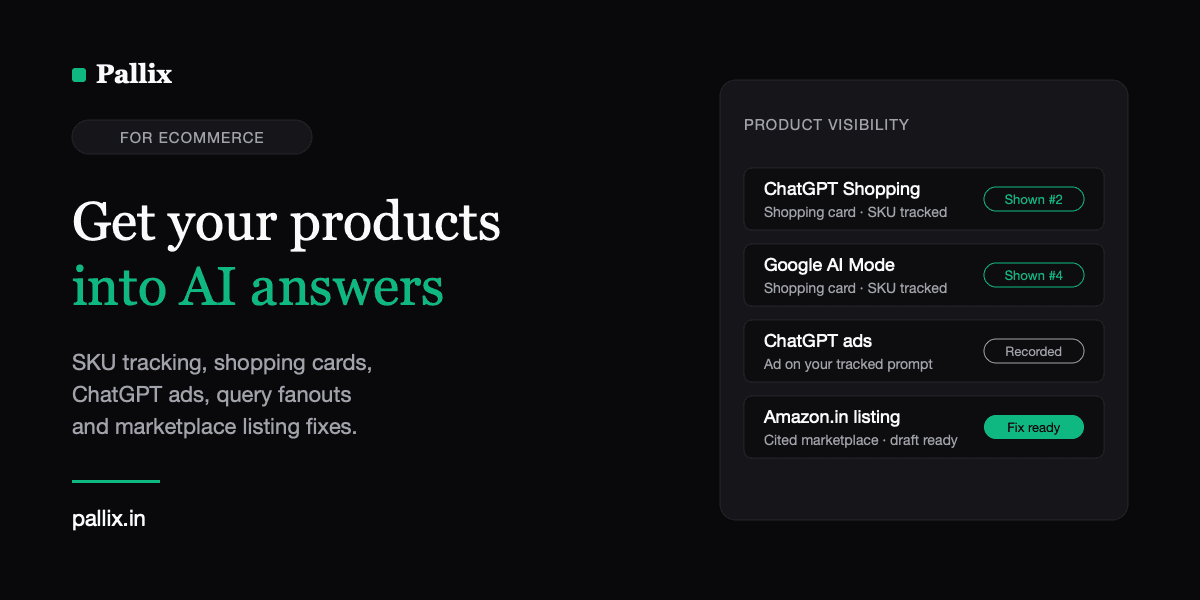
- On Growth and above, Pallix tracks your products at SKU level, reads shopping cards in ChatGPT Shopping, Google AI Mode and Gemini, and shows the ads ChatGPT displays on your prompts.
- Pallix follows the marketplaces AI answers cite, including Amazon.in, Flipkart, Nykaa and Myntra, and drafts improvements to your listings there.
- Every gap comes with a ready-to-use fix, and Pallix shows the fanout queries behind each answer, so you can see what the engine searched for.
Pallix is an AI search optimization tool and AI visibility platform for ecommerce brands. It shows whether ChatGPT, Google AI Mode, Gemini and other AI engines recommend your brand and your products, which ads and marketplaces appear next to them and which sources shape the answer. Then it gives you fixes, written out and ready to use. This guide explains what has changed in AI shopping and walks through how each part of Pallix works for an online store.
AI engines now sell products, not just name brands
A year ago, the question for most brands was simple: does ChatGPT mention us? For an ecommerce brand, that is no longer enough. AI engines now show products, prices, sellers and ads, and some let the buyer check out inside the chat.
- ChatGPT shows products from merchant feeds. OpenAI publishes a product feed spec and notes that eligibility does not guarantee a product will be shown (OpenAI). ChatGPT also shows ads to users on its Free and Go plans (OpenAI help), and ads are live in India (OpenAI).
- Google AI Mode and Gemini draw on Google's Shopping Graph. Google's AI Mode shopping features are live in India in English, and Gemini shopping works in English and Hindi (Google India). Google is also testing a Flipkart buy button in Gemini and AI Mode in India (TechCrunch).
- Google Merchant Center began rolling out AI performance insights, including share of voice on AI surfaces, in markets including India in May 2026 (Google).
The traffic is still small, but it is growing fast. Adobe measured generative-AI traffic to US retail sites up 693.4% year on year over the 2025 holiday season, while noting that the base of users is still modest (Adobe). It expects a further 130% rise for the 2026 season (Adobe).
The two layers of AI visibility for ecommerce brands
An ecommerce brand has two things to watch in AI answers.
- The brand layer. When a buyer asks a category question, does the engine name your brand, where does it place you and how does it describe you?
- The product layer. Do your products appear in shopping cards, at what position and price, and next to which ads?
Buyer prompts
- best sunscreen for oily skin under ₹500
- whey protein brands that are lab tested in India
- running shoes for flat feet, compare top 3
- is [your brand] worth it or are there better options
The first three questions can return a list of brands, a row of product cards and an ad. The last is a brand search, where the pages AI engines cite, including marketplace listings, shape what the buyer reads about you. Pallix tracks both layers in one workspace.
How Pallix works for an ecommerce brand
1. Track the questions your buyers ask, across seven engines
You choose the buyer questions that matter at each stage: discovery, comparison, features, reviews and brand searches (FAQ). Pallix asks them in ChatGPT, Gemini, Google AI Overviews, Perplexity, Copilot, Claude and Grok, and tracks your brand mentions, your position in the answer and which competitors appear on the same prompts (pricing, FAQ).
You also pick the market you're studying. AI answers to "best face serum" differ between India and the UK, so Pallix runs prompts for the audience you sell to (FAQ).
2. Track your products at SKU level
On Growth and above, Pallix tracks individual products, not just your brand name. For each product you see whether AI answers recommend it, where it appears and which competing products show up instead.
This matters because a brand can do well on category questions while its best-selling product never appears. SKU-level data shows which products AI engines know about and which they skip.
3. See your shopping cards in ChatGPT, Google AI Mode and Gemini
When a buyer asks a shopping question, ChatGPT, Google AI Mode and Gemini often answer with product cards: an image, a price and a seller. On Growth and above, Pallix reads these shopping cards for your tracked prompts, so you can see whether your products appear, at what position and at what price next to competitors.
4. See the ads ChatGPT shows on your prompts
ChatGPT now shows ads (OpenAI help). On Growth and above, Pallix records the ads that appear in ChatGPT answers to your tracked prompts, so you know when a paid placement sits next to a question you care about.
5. See the fanout queries behind each answer
AI engines often split one question into several background searches before they answer. This is called query fanout. For "best sunscreen for oily skin under ₹500", an engine might also search for SPF ratings, dermatologist reviews and price comparisons.
Pallix shows these fanout queries for each tracked prompt (capabilities). They tell you which questions your product pages, FAQs and listings need to answer before an engine will pick you.
6. Follow the marketplaces AI answers cite
AI answers about products often cite marketplace pages for details, prices and reviews. Pallix shows which marketplaces appear as sources in your category, including Amazon.in, Flipkart and Nykaa (home) as well as Myntra. If a marketplace page is shaping the answer about your product, you'll know which one.
7. Get marketplace listing fixes
If your listing on a marketplace is thin, out of date or missing the details AI engines look for, the answer about your product will be too. On Growth and above, Pallix drafts improvements to your listings on Amazon.in, Flipkart, Nykaa and Myntra, based on what AI answers in your category draw on.
8. Get fixes that are ready to use
Pallix turns every gap into a ranked action across content, authority, technical readiness and market presence (capabilities). Each one comes with a ready-to-edit draft: pages to publish or update, FAQs to add, marketplace listings to improve and sources to get featured on (home). Your team copies the draft, edits it if needed and publishes it, rather than writing from scratch.
9. Watch your category, not just your brand
Growth adds Market Intel for up to five categories, with social, marketplace and editorial signals and price-band movement (pricing). Use it to see how AI engines treat your category as a whole and where prices are moving.
Which Pallix plan fits an ecommerce brand?
Every plan is priced per brand, with unlimited seats (pricing).
| Plan | Price | Prompts and refresh | Engines | Ecommerce features |
|---|---|---|---|---|
| Starter | ₹2,249/month billed annually, or ₹2,499 billed monthly | 30 prompts, refreshed twice a week | ChatGPT, Gemini and Google AI Overviews | Brand tracking, competitors, citations including marketplaces, fanout queries and fixes |
| Growth | ₹5,399/month billed annually, or ₹5,999 billed monthly | 50 prompts, refreshed daily | Any 5 of the 7 | Everything in Starter, plus SKU tracking, shopping cards, ChatGPT ads data, marketplace listing fixes and Market Intel |
| Agency / Enterprise | Custom | 200+ prompts | All 7 | Everything in Growth, plus multi-brand and white-label |
Most ecommerce brands should start on Growth, since that is where the product-level features begin. Starter suits a brand that first wants to see how AI engines talk about it at category level. Agency/Enterprise suits teams running several brands or a large catalog.
You can try Pallix free for 7 days with up to 20 prompts on ChatGPT, Gemini and Google AI Overviews (pricing).
Run a free AI visibility audit →
What you still need to do yourself
Pallix shows you where you stand and drafts the fixes. A few things sit with your team.
Keep your product feed clean. AI shopping results run on feeds. ChatGPT reads merchant feeds built to OpenAI's spec (OpenAI), and Google AI Mode draws on the Shopping Graph and Merchant Center (Google). Missing prices, out-of-date stock or vague titles will hold your products back.
Make your product pages readable. AI engines can only quote pages they can fetch and parse. If your product details load with JavaScript or sit inside images, start there. Our guide to technical readiness for AI covers the checks.
Publish the fixes. A drafted FAQ or listing only helps once it's live. Then watch the next refresh to see what changed.
To see which sources AI engines lean on in Indian categories, read our India AI sourcing index. For how engines pick brands, see how ChatGPT decides which brands to recommend.
Frequently asked questions
What is an AI search optimization tool for ecommerce?
It is software that tracks whether AI engines such as ChatGPT, Google AI Mode and Gemini recommend your brand and products, and helps you fix the gaps. Pallix also tracks shopping cards, ChatGPT ads and the marketplaces AI answers cite.
What should AI visibility software for ecommerce measure?
Whether AI answers name your brand on category questions, whether your products appear in shopping cards, which ads show on your prompts and which sources, including marketplaces, the answers cite.
Does Pallix track individual products?
Yes. On Growth and above, Pallix tracks products at SKU level and reads shopping cards in ChatGPT Shopping, Google AI Mode and Gemini.
Does Pallix show ads in ChatGPT?
Yes. On Growth and above, Pallix records the ads that ChatGPT shows on your tracked prompts.
Which marketplaces does Pallix cover?
Pallix follows Amazon.in, Flipkart, Nykaa and Myntra as sources in AI answers, and on Growth and above it drafts improvements to your listings there.
What are fanout queries?
Fanout queries are the background searches an AI engine runs to build one answer. Pallix shows them for each tracked prompt, so you can see what the engine looked for.
Which AI engines does Pallix track?
ChatGPT, Gemini, Google AI Overviews, Perplexity, Copilot, Claude and Grok (pricing).
Does Pallix work for Indian ecommerce brands?
Yes. You choose the market you study, and Pallix follows the marketplaces AI answers cite in India, such as Amazon.in, Flipkart, Nykaa and Myntra.
Is there a free trial?
Yes. The trial runs for 7 days with up to 20 prompts on ChatGPT, Gemini and Google AI Overviews (pricing).