AI Visibility
Free AI Visibility Audit: Check If ChatGPT Recommends Your Brand
Twenty prompts, three engines, sixty live checks and about ten minutes, plus the sources the engines actually read and what a free audit cannot do.
Contents(6 sections)
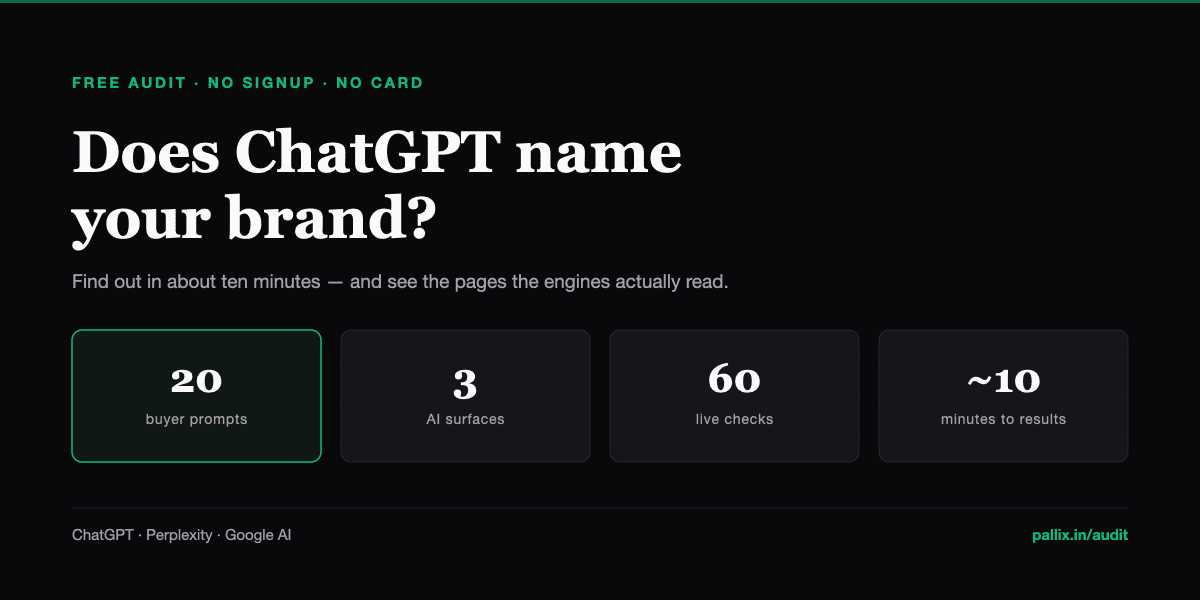
Run a free AI visibility audit at pallix.in/audit. It queries ChatGPT, Perplexity and Google AI with 20 buyer prompts (60 live checks in total), returns results in about ten minutes, and requires no signup and no card.
You get your visibility score, which prompts mention you, which competitors appear instead, and (the part most free tools skip) the actual sources those engines read to build their answers.
What the audit tells you
| Included | |
|---|---|
| Engines queried | ChatGPT, Perplexity, Google AI |
| Prompts run | 20, generated for your category |
| Live checks | 60 (20 prompts × 3 surfaces) |
| Time to results | ~10 minutes |
| Signup | Not required |
| Card | Not required |
| Market | Country and city you specify |
Four things come back:
Your visibility score: how often AI engines name your brand across the prompts your buyers are likely to ask.
Prompt-level results: which specific questions surface you and which do not. Most brands find the split is sharper than expected: strong on some phrasings, entirely absent on others.
Competitors named instead: the brands appearing in answers where you do not. This is frequently the most useful part, because the list usually contains names you were not tracking.
The sources behind the answers: the specific pages engines read. Not domain names, the actual URLs, and whether they mention your competitors but not you.
Why the source data matters more than the score
A score tells you that you have a problem. It does not tell you where the problem lives.
When an AI engine answers a commercial question, it splits the question into sub-questions, retrieves pages for each, and assembles a recommendation from the brands present on those pages. So the practical question is "am I on the pages the engine went to?"
Across our tracked network of 19 brands and 96,947 citations, competitor-owned websites supply 41.4% of everything AI cites cross-industry, and brand-owned sites supply about 7%. For most brands, the answer being given about them is assembled from pages they do not control. In Indian category answers specifically the split is starker still: 51.6% to competitors against 5.8% to the brand being asked about.
The audit shows you which pages those are.
What a free audit cannot do
Stated plainly, because the limits determine when free stops being enough:
- It is a one-time snapshot. AI answers vary from run to run and day to day, and a single measurement cannot distinguish a real change from normal variation.
- Twenty prompts is a sample. Enough to establish whether you have a problem; not enough to cover a category.
- Three of seven engines. The audit covers ChatGPT, Perplexity and Google AI. Pallix tracks seven in total: Gemini arrives on the ₹2,499 Starter plan, and Growth at ₹5,999 covers any five of the seven, including Copilot.
- No competitor benchmarking over time, no content generation, no alerts.
If the audit shows you are absent from most prompts, that is the answer you needed and it cost nothing. If it shows something more mixed, ongoing tracking is what tells you whether it is moving.
Other free ways to check
Worth knowing, because no single free tool covers everything:
- HubSpot AI Search Grader: free, no account, a one-time snapshot across ChatGPT, Perplexity and Gemini scoring sentiment, presence quality, brand recognition, share of voice and market competition out of 100.
- AthenaHQ Essential: a genuine free plan with 300 credits across five engines, including Copilot.
- Google Search Console and Bing Webmaster Tools: free forever, and they show whether your pages are indexed at all, which the AI tools cannot. Google AI Overviews only link to pages that are indexed in Google Search, and Bing Webmaster Tools runs the same check against Bing's index. An unindexed page cannot be cited regardless of quality.
- Asking the engines directly: turn off personalisation and memory, ask your buyers' questions, and run each several times, since ChatGPT issues different searches on repeat runs.
A useful free sequence: run the audit, check indexation in both webmaster tools, then ask the three engines manually for your five most commercial queries. For what the paid tier of this category costs when you get there, see six self-serve AEO tools compared.
Frequently asked questions
How do I check if ChatGPT mentions my brand for free?
Run a free audit that queries ChatGPT directly, or ask ChatGPT yourself with search enabled and personalisation off, using the questions your buyers would ask. Run each question several times, because ChatGPT issues different search queries on repeat runs, so a single check tells you very little.
Is the Pallix audit really free?
Yes. It needs no signup or card and does not convert into a paid plan. It runs 20 prompts across ChatGPT, Perplexity and Google AI (60 live checks) and returns results in about ten minutes.
What is the difference between a free audit and a free trial?
An audit is a one-time snapshot that costs nothing and expires nothing. A trial is temporary access to a paid product, usually 7 to 14 days. Most tools in this category offer trials rather than free audits. Pallix runs both: the audit needs no account, and a separate 7-day trial covers up to 20 prompts daily on ChatGPT, Gemini and Google AI Overviews.
How long does an AI visibility audit take?
About ten minutes for the Pallix audit. The engines are queried live rather than from a cache, which is why it is not instant.
What should I do if the audit shows low visibility?
Look at the sources rather than the score. If the pages being cited are third-party comparisons, marketplaces or directories, the work is getting onto those pages rather than publishing more on your own site. Our data shows brand-owned sites supply only about 7% of citations across a 19-brand network.
Do I need a paid tool after the audit?
Only if you need to know why rather than whether. Free tools answer whether you have a problem. Tracking over time, source-gap analysis and competitor benchmarking are what tell you what to change.
Run it
The audit needs no signup, and results arrive in about ten minutes.
Audit specifications read from the live audit page on 28 August 2026. Network citation data from the Pallix network, 30 days to 5 August 2026.