AI Visibility
6 Best Self-Serve AEO Tools for D2C Brands in 2026
Six AEO tools you can sign up for without a demo — entry pricing verified on each vendor's live page, engine counts, and where each one loses.
Contents(11 sections)
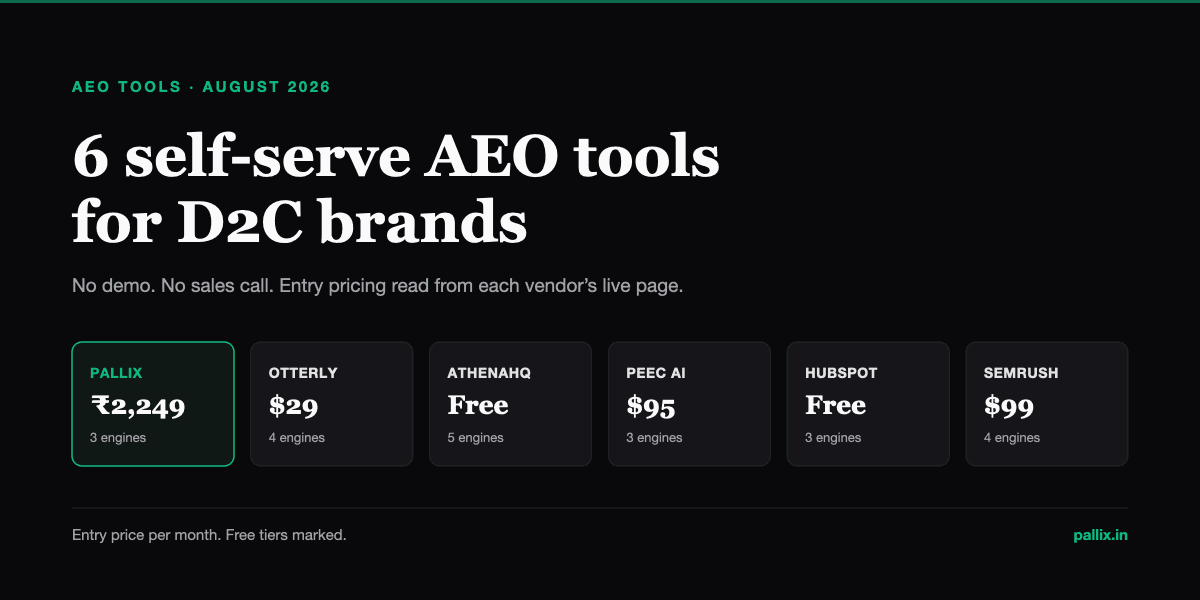
The best self-serve AEO tools for D2C brands in 2026 are Pallix (₹2,499/mo, three engines at entry and any five of seven from ₹5,999, per-prompt market querying), Otterly ($29/mo, four engines, free GEO tools), AthenaHQ (free plan across five engines, revenue attribution), Peec AI ($95/mo, deliberately simple), HubSpot AI Search Grader (free, one-time snapshot) and Semrush ($99/mo per domain, if you already subscribe).
Self-serve means you can sign up, get a result, and decide — without a demo, a sales call or a procurement conversation. That rules out a large part of this category.
Disclosure: Pallix publishes this list and appears first in it. Every competitor price below was read from that vendor's own live pricing page in August 2026, and where each tool loses is stated — including Pallix.
The six compared
| Tool | Entry price, billed monthly | Engines at that price | Start without a sales call | Free option |
|---|---|---|---|---|
| Pallix | ₹2,499/mo (₹2,249 on annual) | 3 (any 5 of 7 from ₹5,999) | Yes | Audit, no signup + 7-day trial |
| Otterly | $29/mo | 4 (Claude, Gemini, AI Mode extra) | Yes | Trial + free GEO tools |
| AthenaHQ | Free, then $295/mo | 5 free, 9 paid | Yes | Free plan, 300 credits |
| Peec AI | $95/mo | 3 of 6 | Yes | 7-day trial |
| HubSpot AI Search Grader | Free | 3 | Yes | Fully free |
| Semrush | No monthly option — $99/mo per domain on annual billing only | 4 | Yes | 7-day trial |
A note on comparing these numbers: the table is normalised to monthly billing, because that is the only basis on which all six can be lined up. Vendors do not quote that way — Pallix and Semrush headline an annual-billing rate, and Semrush does not sell the toolkit monthly at all, so its $99 is an annual commitment shown here for comparison. Annual billing takes 15% off Otterly, 17% off AthenaHQ and roughly 15% off Peec.
For a wider field that includes the enterprise end of the category, see the nine AI visibility tools compared for Indian brands.
Why AEO looks different for D2C
AEO — answer engine optimization — is the practice of getting your brand named when someone asks an AI engine for a recommendation. For D2C brands specifically, where those answers come from is not what most guidance assumes.
Across two Indian D2C brands we tracked over 30 days, marketplaces supplied 23.9% and 29.7% of all citations, with Amazon India the largest single source for both. Across a 19-brand cross-industry benchmark spanning software, finance and healthcare, marketplaces supplied 7.2%.
Competitor-owned sites ran the other way: 41.4% cross-industry, but 12.7% and 20.3% for the two D2C brands — a pattern consistent with our wider study of how AI engines cite Indian brands.
The practical consequence is that for a D2C brand, your marketplace listings are a primary input to what AI tells buyers about you — and a tool that cannot see the marketplace layer in your market is measuring the wrong thing.
1. Pallix
Queries run on localised IPs with region and language set per prompt, including code-mixed Hinglish. Beyond the visibility score, it reports the exact cited URLs and raw answer text, flags which of those pages list competitors but not you, splits sentiment by attribute, and turns those gaps into publishable blog drafts and FAQ answers. The scoring formula is visible and editable.
Best for: D2C brands selling in India or other non-US markets that need per-market accuracy.
Pricing: ₹2,249/mo Starter billed annually — ₹2,499 billed monthly — for 30 prompts, twice-weekly refresh, across three AI surfaces. ₹5,399/mo Growth (₹5,999 monthly) for 50 prompts, daily refresh, across any five of seven engines: ChatGPT, Perplexity, Google AI Overviews, Gemini, Copilot, Claude and Grok. Custom Agency tier from 200 prompts. A free audit runs with no signup, and a 7-day trial covers up to 20 prompts daily on ChatGPT, Gemini and Google AI Overviews; a card is required at signup and nothing is charged during the trial.
Where it loses: the ₹2,249 entry tier is three surfaces and a twice-weekly refresh, so the five-engine daily comparison is really ₹5,399 — and five engines still trails nine on AthenaHQ paid. No SOC 2, no SSO, no MCP server.
2. Otterly
The cheapest paid entry, and the strongest free tooling in the category — AI keyword research, query fan-out, GEO content check and crawler simulation are all free and standalone. Lite covers 15 prompts across four engines (ChatGPT, Google AI Overviews, Perplexity and Microsoft Copilot) with unlimited team members and 1,000 GEO URL audits a month; Standard adds API and MCP access at 2,000 requests each.
Best for: testing whether AI search matters for your category before committing budget.
Pricing: $29 Lite, $189 Standard, $489 Premium, all monthly-billing rates with 15% off annually. Enterprise starts around $1,000/mo.
Where it loses: the add-on charges land on three engines that matter — on Lite, Claude is a further $29, with Google AI Mode and Gemini $9 each, so tracking seven engines roughly doubles the entry price. No market-specific query origin.
3. AthenaHQ
The only genuine free plan from a full platform — 300 credits across five engines (ChatGPT, Perplexity, AI Overviews, Gemini and Claude) with unlimited members. Paid tiers reach nine models with unlimited competitor tracking and GA4, Search Console, Shopify and Webflow integrations. For a D2C brand on Shopify, that integration connects visibility to orders directly.
Best for: D2C teams that need to show AI visibility affecting revenue.
Pricing: Essential free with 300 credits. Starter $295/mo with 3,600 credits, 17% off billed annually. API access and extra credits are paid add-ons on top of Starter, priced on request.
Where it loses: one credit is one AI response, so consumption is hard to forecast before you start; Starter is single-region, with multi-region and multi-language reserved for Enterprise.
4. Peec AI
Restraint is the product decision, and customers cite it approvingly. Three models chosen from six, daily tracking, unlimited users, one clear number.
Best for: small D2C teams that want a visibility figure and no onboarding overhead.
Pricing: $95 Starter (50 prompts, 1 project), $245 Pro (150 prompts, 2 projects), $495 Advanced (350 prompts, 5 projects) on monthly billing; $80, $205 and $420 billed annually. A 7-day trial needs no card.
Where it loses: every self-serve tier is capped at three models, and a fourth is a paid add-on running $30 to $140 per model per month depending on tier. There is no fixing layer at all — it reports, and stops.
5. HubSpot AI Search Grader
Free, no account, one-time snapshot across ChatGPT, Perplexity and Gemini, scoring sentiment, presence quality, brand recognition, share of voice and market competition out of 100. Not a monitoring platform, but the fastest way to establish whether you have a problem.
Best for: a first check before spending anything.
Pricing: free. HubSpot now sells a separate paid product, HubSpot AEO, at $50/mo for week-over-week monitoring across the same three engines.
Where it loses: the free grader gives no tracking over time, no cited URLs and no competitor benchmarking — for continuity you are buying the $50/mo product, not using the grader.
6. Semrush AI Visibility Toolkit
Defensible as consolidation if the subscription already exists, since AI visibility lands beside your keyword and backlink work. Covers ChatGPT, Google AI, Gemini and Perplexity, with 25 custom prompts tracked daily at the base rate.
Best for: D2C teams already paying for Semrush.
Pricing: $99/mo per domain, billed annually — there is no monthly option at that rate. Additional users start at $45/mo. A 7-day trial is available.
Where it loses: per-domain pricing punishes multi-brand operations, the annual commitment is the only way in at $99, and reviewers note it models presence with simulated prompts rather than live sessions.
How to choose, for a D2C brand specifically
- Does it see your marketplace layer? Marketplaces supply roughly a quarter of D2C citations. A tool that only reads your website is missing the largest single source.
- Where do its queries originate? Ask in infrastructure terms, not marketing terms. "We support India" and "we query from Indian IPs" are different claims.
- Compare like with like on price. Check whether the headline number is a monthly rate or an annual-billing rate, and how many engines it actually includes — several tools on this list count an engine you have to pay extra for.
- Can you start without a sales call? All six above pass this. Much of the rest of the category does not.
- Does it explain, or only report? A score tells you there is a problem. Cited URLs and source gaps tell you where it lives.
- What does it cost in your currency? Dollar billing on a monthly subscription puts currency risk on you.
Frequently asked questions
What is a self-serve AEO tool?
An AEO tool you can sign up for, run and evaluate without a demo, sales call or procurement process. Pallix, Otterly, AthenaHQ, Peec, HubSpot's grader and Semrush all qualify; much of the enterprise end of the category does not.
What is the best AEO tool for D2C brands?
It depends on where you sell. Pallix for per-market accuracy outside the US, AthenaHQ if you need revenue attribution through Shopify or GA4, Otterly at $29 if you are testing the channel, and HubSpot's free grader if you want a first look at no cost.
Is there a free AEO tool for D2C brands?
Yes. HubSpot's AI Search Grader is fully free with no account. AthenaHQ's Essential plan is a genuine free plan with 300 credits across five engines. Pallix runs a free audit with no signup, plus a 7-day trial. Otterly and Peec offer trials rather than free plans — Peec's runs 7 days with no card.
Do AEO tools help with Amazon and marketplace listings?
Indirectly, by showing you that marketplaces are where your citations come from. Across two Indian D2C brands, marketplaces supplied 23.9% and 29.7% of citations with Amazon India the top source. Tools that report cited URLs will show you which listings are being read; none of them edit your listings for you.
AEO or GEO — what is the difference?
They describe the same practice. AEO stands for answer engine optimization, GEO for generative engine optimization. Both mean getting your brand named and cited in AI-generated answers, and vendors use the terms interchangeably — the longer explanation is in our guide to AEO and GEO.
How much should a D2C brand spend on AEO tooling?
Start free — HubSpot's grader, AthenaHQ Essential or a Pallix audit — and only pay once you know whether you have a problem. Paid entry across this list runs from ₹2,249 (~$26) to $295 per month, and the cheapest tier is rarely the full-coverage tier: budget for the engines you actually want tracked rather than the headline rate.
References
- Pallix pricing
- Otterly pricing
- AthenaHQ pricing
- Peec AI pricing
- HubSpot AI Search Grader
- Semrush AI Visibility Toolkit pricing
Every figure above was read from the vendor's own live pricing page on 25 August 2026, not from a third-party roundup. D2C citation data from the Pallix network, 30 days to 5 August 2026. Rates in this category move frequently — confirm before you buy.
If Pallix made your shortlist, current INR rates are on the Pallix pricing page, and the free audit needs no signup.