AI Visibility
Top AI Tools to Capture High-Intent Traffic, and How to Choose One
Keyword tools show what buyers search. Pallix shows what AI engines tell them when they ask which brand to pick. Here is how to choose the right mix.
Contents(8 sections)
Pallix shows marketing teams where their brand appears when buyers ask AI engines which product to pick. It also shows which sources shape those answers and which gaps to fix first. That matters because the path to a purchase now has an extra step. Most guides on high-intent traffic list SEO tools for finding buying keywords, and then they stop. Those tools are still essential. Buyers, however, now also ask ChatGPT, Perplexity and Google AI Overviews to compare brands and name a winner. This guide covers both steps. You will see how to find high-intent demand, and how to check what AI engines tell buyers about your brand.
Key takeaways
- High-intent traffic comes from people who are ready to compare, choose or buy.
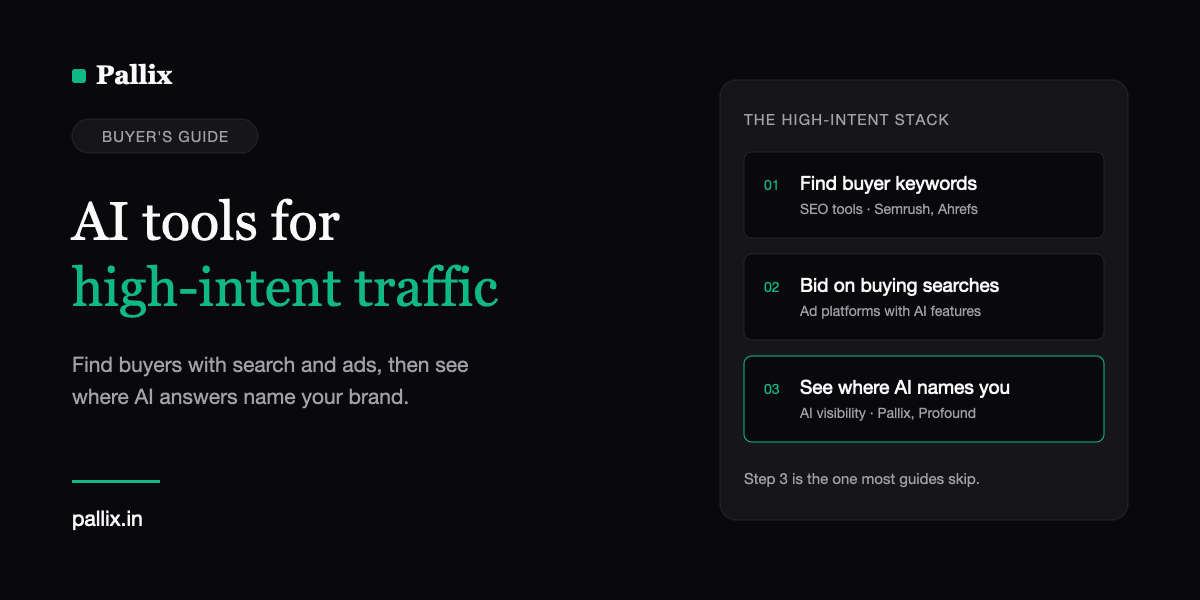
- SEO and keyword tools such as Semrush and Ahrefs help you find and rank for high-intent searches.
- Ad platforms with AI features help you bid on those searches and target the right buyers.
- AI visibility tools such as Pallix and Profound show where your brand appears in AI answers and which sources shape them.
- Most teams need both a keyword tool and an AI visibility tool, because each one covers a different step.
What high-intent traffic means
High-intent traffic is visits from people who are close to a buying decision. They already understand their problem and are now comparing options, checking prices or looking for a vendor.
Their queries show it. "Best CRM for small teams", "Brand A vs Brand B" and "Brand A pricing" signal a buyer, while "What is a CRM" signals early research.
Search intent usually falls into three stages:
- Informational: the person wants to learn, as in "what is ..." or "how does ... work".
- Commercial: the person compares options, as in "best ...", "... vs ..." or "... alternatives".
- Transactional: the person is ready to act, as in "... pricing", "... demo" or "buy ...".
High-intent traffic sits in the commercial and transactional stages. It is smaller than informational traffic, but each visit comes from someone much closer to a decision.
How to find high-intent buyers
You find high-intent buyers by studying the questions they ask just before they decide. Three sources give you those questions.
- Search data. Keyword tools show which commercial and transactional queries people type, and how often. Look for modifiers such as "best", "vs", "alternatives", "pricing" and "for [use case]".
- Your own data. Sales calls, support tickets and site search show the exact words buyers use. Use those words when you build your query lists.
- AI answers. Buyers now put the same comparison questions to AI engines, often in longer and more specific form. "Best CRM" becomes "Which CRM works best for a ten-person sales team that sells on WhatsApp?" These prompts are high intent by design, because the buyer is asking for a recommendation.
Turn all three sources into one list of buyer questions, grouped by product line and by market. Pallix speeds up this step for AI answers. It uses Google search volume and autocomplete to suggest the buyer prompts people search most.
How to capture them: search, ads and AI answers
You capture high-intent buyers by being present wherever they make their choice, which today means three channels.
Organic search
Rank pages that answer commercial queries directly. Comparison pages, alternatives pages, pricing pages and use-case pages all match buyer intent. Keyword tools tell you which queries to target and how hard each one is to rank for.
Paid search and ads
Bid on transactional and comparison queries where organic ranking is slow or crowded. Ads put you in front of buyers on the day you launch a campaign.
AI answers
When a buyer asks an AI engine which brand to pick, the answer usually names a few brands and cites a few sources. If your brand is missing, you are not on the shortlist. To earn a place there, you need to know three things:
- which buyer questions mention your brand, and which ones do not
- which competitors appear in your place
- which sources the engine draws on, such as review sites, listicles, forums and your own pages
This is the step most high-intent guides skip, and it is the job of an AI visibility tool.
Which types of AI tools support each task
Each task calls for a different type of tool, as the table below shows.
| Task | Tool type | Examples | What it does |
|---|---|---|---|
| Find high-intent keywords and track rankings | SEO and keyword tools | Semrush, Ahrefs | Shows search demand, keyword difficulty, rankings and competitor pages |
| Bid on high-intent searches | Ad platforms with AI features | Search and social ad platforms | Uses AI to suggest keywords, write ad variations and adjust bids |
| See where your brand appears in AI answers | AI visibility tools | Pallix, Profound | Tracks buyer questions across AI engines, brand mentions, competitors and cited sources |
SEO and keyword tools
Semrush and Ahrefs are widely used for finding high-intent keywords. They show what people search, how often, how hard each term is to rank for and which pages rank today. Use them to plan your comparison, alternatives and pricing pages. For a side-by-side view, read how Semrush and Pallix compare on AI visibility.
Ad platforms with AI features
Ad platforms let you pay for a place on high-intent searches. Their AI features suggest keywords, generate ad copy and set bids against a goal you choose. They work best when you already know which queries bring in buyers.
AI visibility tools
AI visibility tools such as Pallix and Profound track how AI engines answer buyer questions. They show whether your brand is recommended, which competitors appear and which sources the engines rely on. This layer answers a different question from keyword and ad tools. Keyword tools show what buyers search, while an AI visibility tool shows what the AI tells them.
How to compare tools by use case
Choose tools by the job you need done, not by the length of the feature list. Start with your main goal, and then add the tool that fills the remaining gap.
| If your goal is to... | Start with | Then add |
|---|---|---|
| Find new high-intent keywords | An SEO or keyword tool | An AI visibility tool to check AI answers on the same topics |
| Win paid traffic on buying searches now | An ad platform | A keyword tool for research |
| Know whether AI engines recommend your brand | An AI visibility tool | A keyword tool for page planning |
| Learn why a competitor wins AI answers | An AI visibility tool that traces sources | A content and PR plan |
| Compare visibility across countries or markets | An AI visibility tool with market settings | Local keyword data |
When you compare AI visibility tools against each other, check these points:
- Engines covered: Does it track the AI engines your buyers actually use?
- Prompts: Can you track real buyer questions, and does the tool suggest the ones people search most?
- Refresh: How often are answers refreshed?
- Competitors: How many competitors can you compare against?
- Sources: Does it show which pages and sites shape each answer?
- Actions: Does it turn gaps into a ranked list of fixes?
- Markets: Can it run queries in the language and location of each market?
- Pricing model: Is it priced per brand, per seat or per prompt?
For a fuller framework, read how to choose an AI visibility tool.
What Pallix does, and what it does not do
Pallix is an AI visibility platform built for marketing teams. It was founded in 2025 and is based in Pune, India.
What Pallix does
- Tracks your brand in AI search. Pallix monitors buyer questions, shows where your brand is recommended and compares you with competitors.
- Suggests the prompts that matter. Pallix uses Google search volume and autocomplete to suggest the most-searched buyer prompts. It also estimates the search demand behind each tracked prompt, so you can prioritize high-demand questions and spot the ones your prompt set misses.
- Traces the evidence. It shows the evidence behind each answer and finds the sources that influence AI answers.
- Covers five AI surfaces. The paid workspace tracks ChatGPT, Perplexity, Google AI Overviews, Gemini and Copilot.
- Ranks your next actions. It turns gaps into ranked actions across content, authority, technical readiness and market presence.
- Separates markets. It adapts query execution, language and sources to each audience, so you can see how visibility differs between markets.
- Starts free. The free AI visibility audit needs no signup. It runs a one-time diagnosis across real buyer-intent prompts. It shows your visibility, missed prompts, leading competitors, citation gaps and first actions.
- Offers a real trial. The self-serve trial creates a real workspace with 20 active prompts, refreshed daily.
- Prices per brand. Every plan includes unlimited seats. Plans differ by prompt volume, refresh cadence, competitor depth and intelligence modules. Starter is listed at ₹2499, or ₹2249 at the discounted listing. Growth is listed at ₹5999, or ₹5399 at the discounted listing. See Pallix pricing for full plan details.
What Pallix does not do
- It does not replace your SEO and keyword tools. Pallix uses search data to choose which prompts to track. Keep using keyword tools for keyword research and organic rankings.
- It does not buy or manage ads. Ad platforms still handle bidding and campaign delivery.
- The free audit is not ongoing tracking. It is a one-time diagnosis. Ongoing tracking runs in the trial or a paid workspace.
Frequently asked questions
Is an AI visibility tool the same as an SEO tool?
No. An SEO tool shows what people search and where your pages rank, while an AI visibility tool shows what AI engines say about your brand.
Do I still need Semrush or Ahrefs if I use Pallix?
Yes. Pallix does not replace keyword tools, so use both for full coverage of search and AI answers.
How does Pallix know which prompts to track?
Pallix uses Google search volume and autocomplete to suggest the buyer prompts people search most. You can then prioritize the prompts with the most demand.
Which AI engines does Pallix track?
The paid workspace tracks ChatGPT, Perplexity, Google AI Overviews, Gemini and Copilot.
Can I try Pallix before I pay?
Yes. You can run the free audit with no signup, or start a self-serve trial with 20 active prompts refreshed daily.
How is Pallix priced?
Pallix is priced per brand with unlimited seats. Starter is listed at ₹2499 and Growth at ₹5999, with lower discounted listings on the pricing page.
Can Pallix show visibility in different countries?
Yes. Pallix adapts query execution, language and sources to each audience, so you can compare visibility between markets.
Tool-selection checklist
Work through these six points before you pick a tool.
- Goal. Write down the one job the tool must do first: find keywords, buy traffic or check AI answers.
- Where your buyers ask questions. List the search engines and AI engines your buyers use, and confirm the tool covers them.
- Markets. Name every country and language you sell in, and check that the tool can separate them.
- Budget. Decide your monthly spend, and note whether each tool charges per brand, per seat or per prompt.
- Team size. Count who needs access. Per-seat pricing grows with your team, while per-brand pricing does not.
- Next step. See where your brand stands in AI answers today before you commit to a plan.