AI Visibility
The Pallix India AI Sourcing Index — August 2026
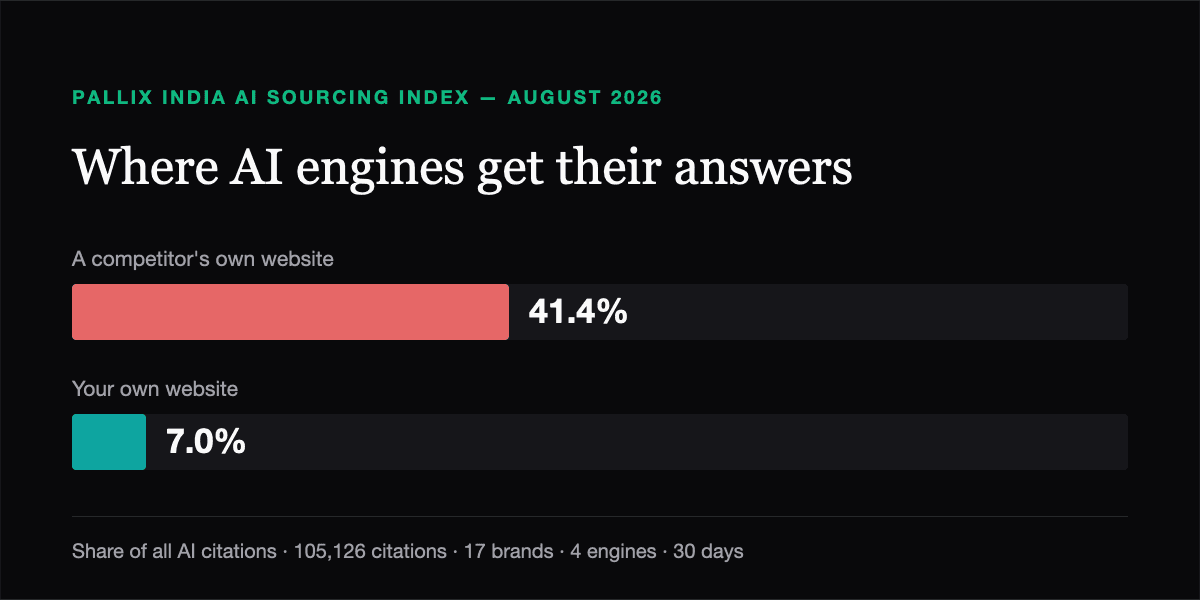
105,126 citations across 17 brands and four AI engines. Where AI actually gets its answers — and why 41.4% of it is a page your competitor wrote.
Contents(8 sections)
Key takeaways
- Competitor-owned websites are 41.4% of every source AI engines cite. Brand-owned sites are just 7%.
- Ranking and comparison pages are the fastest-rising source type, up 2.8 points to 16.4%.
- ChatGPT is the outlier: 66.8% of its citations are competitor sites, and ranking pages are 0.1%.
- Freshness is set by source type, not by engine. Reviews age out in weeks; reference content is cited for years.
- Based on 105,126 citations across 17 brands and four AI engines, on India-weighted queries, over 30 days.
Where AI engines actually get their answers. This is the first edition of our monthly AI citation tracking index: 105,126 citations, 17 brands, four AI engines, thirty days. If you care about AI search visibility, the question underneath all of it is simple — when an engine describes your category, what is it reading?
Across everything we track, 41.4% of every source AI engines cite is a competitor's own website. Not a review site, not a marketplace, not the press. A rival's own pages.
Brand-owned sites account for 7%.
So when an AI engine describes your brand, the single most likely thing it is reading is a page your competitor wrote.
The full AI citation source mix
Share of all citations captured across 17 tracked brands, 30 days to 5 August 2026, queried from localised, India-weighted IPs across ChatGPT, Perplexity, Google AI Overviews and Microsoft Copilot. Change measured against the prior 30 days on a consistent 9-brand base.
| Source type | Share | Change | Largest single source |
|---|---|---|---|
| Competitor sites | 41.4% | ▼ 1.3 | — |
| Ranking & comparison | 16.4% | ▲ 2.8 | worldmetrics.org |
| Editorial | 10.1% | ▼ 0.8 | medium.com |
| Marketplaces | 7.6% | ▲ 1.5 | google.com |
| Brand sites (owned) | 7.0% | ▲ 2.0 | — |
| YouTube | 4.1% | ▼ 1.8 | youtube.com |
| Other | 3.6% | ▲ 0.7 | paisabazaar.com |
| Knowledge & reference | 3.1% | ▲ 0.7 | nih.gov |
| News media | 2.1% | ▼ 1.4 | indiatimes.com |
| 1.6% | ▼ 1.2 | linkedin.com | |
| Review sites | 1.4% | ▼ 0.5 | clutch.co |
| 1.3% | ▼ 0.6 | reddit.com | |
| Quora | 0.1% | ▲ 0.1 | quora.com |
| Community & forums | 0.1% | ▼ 0.1 | slashdot.org |
| Social profiles | 0.1% | ▼ 0.2 | substack.com |
Three things this month's data says
1. Ranking and comparison pages are rising faster than anything else
Up 2.8 points, the largest single move in the dataset, to 16.4% of all citations. These are "best X" and "top N" pages — the enumeration layer.
Combined with competitor sites at 41.4%, that means roughly 58% of everything AI cites is either a rival's own site or a page ranking the category. Both are pages that list brands.
The largest single source in this category is worldmetrics.org — a statistics aggregator, not a publisher anyone would name as an authority. Retrieval does not weight prestige the way people assume.
2. Social and community sources are falling almost across the board
YouTube down 1.8 points. News media down 1.4. LinkedIn down 1.2. Reddit down 0.6. Review sites down 0.5. Social profiles down 0.2. Community and forums down 0.1. The single exception is Quora, up 0.1 from a 0.1% base — movement too small to read anything into.
Conversational and social source types declined almost uniformly this month, while structured, list-shaped sources rose. If that holds across editions it is the most strategically important trend in this data. One month is not a trend — we will report it again in September.
3. Brand-owned sites rose 2 points, from a very low base
Owned sites moved from roughly 5% to 7% of citations. Real movement, and the second-largest rise in the dataset.
But at 7% against competitors' 41.4%, the asymmetry is the story. Companies are being described to buyers primarily through pages they do not control — which is the same mechanism behind why AI keeps recommending your competitor.
Engine-level: ChatGPT sources very differently
The blend is not uniform across engines. Anyone tracking ChatGPT brand mentions should read this table before assuming what works on Perplexity works here. ChatGPT's own mix, over 8,331 citations:
| Source type | ChatGPT | Network average |
|---|---|---|
| Competitor sites | 66.8% | 41.4% |
| Brand sites | 11.9% | 7.0% |
| Other | 7.1% | 3.6% |
| Knowledge & reference | 4.5% | 3.1% |
| Marketplaces | 3.9% | 7.6% |
| Editorial | 2.0% | 10.1% |
| News media | 2.0% | 2.1% |
| 1.3% | 1.3% | |
| YouTube | 0.3% | 4.1% |
| Ranking & comparison | 0.1% | 16.4% |
The ten source types above account for 99.9% of ChatGPT's citations. The remaining five types — LinkedIn, Quora, review sites, community and forums, and social profiles — together round to 0.1% and are omitted.
Two figures stand out. ChatGPT draws two-thirds of its citations from competitor-owned sites — well above every other engine. And ranking and comparison pages, 16.4% of the network average, are 0.1% of ChatGPT's citations.
The source type rising fastest overall is almost absent from the largest engine. A strategy built on comparison-page placement is a strategy aimed at Perplexity, Google AI Overviews and Copilot — not at ChatGPT.
How old is the content AI cites?
Median age of cited content, by engine and source type:
| Source type | Perplexity | Google AI Overviews | Copilot | ChatGPT |
|---|---|---|---|---|
| Editorial | 11 months | 6 months | 4 months | 5 months |
| News media | 1.8 years | 1.5 years | 4 months | 27 days |
| YouTube | 1.1 years | 10 months | 4 months | — |
| 1.1 years | 12 months | — | 10 months | |
| Review sites | 27 days | 9 months | 3 months | — |
| Reference | 5.2 years | 2.6 years | 7 months | 12.5 years |
Perplexity cites review content with a median age of 27 days while citing reference material with a median age of 5.2 years. Same engine, same window. Freshness requirements are set by source type, not by engine policy.
The practical implication: a two-year-old editorial page is still working. A two-year-old review is not.
What this means for your AI search visibility
Get onto pages that list brands. Between competitor sites and ranking pages, roughly 58% of citations come from pages that enumerate a category. Your own site is 7% of the total. Most generative engine optimization advice still starts with your own content; this data says the leverage is mostly off it.
Pick your engine deliberately. Comparison-page placement barely registers on ChatGPT, where competitor-owned content is 66.8% of citations. Being included in a rival's comparison article is the underused route there.
Do not over-invest in social. Nearly every social and community source type declined this month. They still matter for buyers; they are a shrinking share of what engines read.
Match refresh cadence to source type. Review content needs updating within weeks. Editorial holds for months. Reference content holds for years.
Make sure engines can read you at all. None of the above helps if your pages are invisible to retrieval in the first place — see why AI can't cite a site it can't read.
Method and limitations
This index is built from the same citation intelligence pipeline behind our brand-level tracking, aggregated so that no single client is identifiable.
Engines reported: ChatGPT, Perplexity, Google AI Overviews, Microsoft Copilot
Engine excluded: Gemini. It is tracked, but its citation extraction did not produce data reliable enough to report this edition, so it is excluded from every figure above rather than partially represented. It returns when the extraction is sound.
Query origin: localised IPs, India-weighted
Languages: English and code-mixed Hinglish
Window: 30 days to 5 August 2026
Sample: 105,126 citations across 17 brands
Classification: cited domains grouped into 15 source types by a fixed rule set applied identically to every brand
Change base: month-over-month movement is measured on a consistent 9-brand subset, since the tracked set grew during the period. Share figures use all 17 brands; change figures use the 9.
Limitations, stated plainly:
- Brands are aggregated. No individual brand is identified, and competitor and brand-site categories are shown as totals only.
- The tracked set is weighted toward Indian D2C, B2B software, healthcare and services. It is not a random sample of the internet.
- Month-over-month movement on a 9-brand base carries wide uncertainty. A single month's change is directional, not conclusive. We will say so every edition.
- Citation extraction differs by engine. Where an engine's extraction behaves anomalously we exclude rather than report it — which is why Gemini does not appear in this edition.
For the brand-level view of the same market, see our study of AI visibility for Indian brands.
Frequently asked questions
What sources do AI engines cite most?
Competitor-owned websites, at 41.4% of all citations across 17 tracked brands. Ranking and comparison pages are second at 16.4%, followed by editorial at 10.1% and marketplaces at 7.6%. Brand-owned sites account for 7%.
Do AI engines cite a brand's own website?
Rarely, relative to third-party sources. Owned sites are 7% of citations against 41.4% for competitors' sites. On ChatGPT specifically the gap is wider: 11.9% owned against 66.8% competitor-owned.
Which source type is growing fastest in AI citations?
Ranking and comparison pages, up 2.8 points month over month to 16.4%. Brand sites rose 2 points and marketplaces 1.5. YouTube fell furthest, down 1.8 points.
Does ChatGPT cite different sources than Perplexity or Google AI Overviews?
Substantially. Ranking and comparison pages are 16.4% of citations network-wide but 0.1% on ChatGPT, where competitor-owned sites account for 66.8%. Comparison-page placement is therefore a Perplexity, AI Overviews and Copilot strategy far more than a ChatGPT one.
How fresh does content need to be to get cited by AI?
It depends on source type rather than engine. Perplexity cites review content with a median age of 27 days but reference content with a median age of 5.2 years. Editorial content sits between, at four to eleven months across engines.
How do you track brand mentions in ChatGPT and Perplexity?
By running a fixed prompt set against each engine on a schedule, from localised IPs, then extracting and classifying every cited source in the answers. That is what produces the AI citation tracking data in this index: the mention itself is only half the signal, and the source behind it tells you which page to go and influence.
Is there an AI visibility report for Indian brands?
This index is the source-level view, published monthly and weighted toward Indian D2C, B2B software, healthcare and services. For the brand-level view — who gets recommended and who does not — see our study of AI visibility for Indian brands.
Why is Gemini excluded from this edition?
Gemini is tracked, but its citation extraction did not produce data we consider reliable enough to publish for this window. Rather than report a partial figure alongside four sound ones, we exclude it entirely and say so. It returns to the tables once the extraction is sound.
How is this index calculated?
Citations are extracted from AI answers collected daily across four reported engines from localised IPs, then classified into 15 source types by a fixed rule set. Figures are aggregated across all tracked brands; no individual brand is identified.
Cite this index
Pallix India AI Sourcing Index, August 2026. https://pallix.in/blog/india-ai-sourcing-index
This is a recurring index. The next edition publishes in September 2026, on the same query set and window length.