AI Visibility
How Pallix Measures AI Visibility: Methodology, Metrics and Scoring
Which AI engines Pallix asks, from where, which questions count, how each answer is read, how the visibility score is calculated, how to change the weights.
Contents(10 sections)
- Which AI engines does Pallix check, and how are answers captured?
- Where are the questions asked from?
- Which questions are counted?
- How is each answer read?
- How are the scores calculated?
- How to set the scoring to your brand's goal
- How many answers does a score need?
- How are fixes ranked and measured?
- Where can I check Pallix research?
- Frequently asked questions
Pallix runs the buying-intent questions people ask AI ("best sunscreen for oily skin under ₹500") on up to seven AI engines from inside your chosen country, stores every full answer, and records whether each AI named you, in what position, in what tone, and which web pages it cited. Every metric on your dashboard is calculated from these AI answers. Pallix gives you a scoring formula you can customise to your brand's goal, whether that is getting mentioned, ranking near the top, or giving more weight to a particular AI engine.
This post explains how each metric and data point on your Pallix dashboard is calculated, how we suggest prompts and how we track them. A prompt here means one buyer question that Pallix tracks. An answer means one AI engine replying to one prompt on one day.
Key takeaways
- Pallix checks ChatGPT, Gemini, Google AI Overviews, Perplexity, Copilot, Claude and Grok, reading the answer the consumer app shows, asked from inside your market.
- Each answer is read by a language model that records whether your brand is named, its position, its tone, the competitors named, the cited pages, and any factual error about your brand.
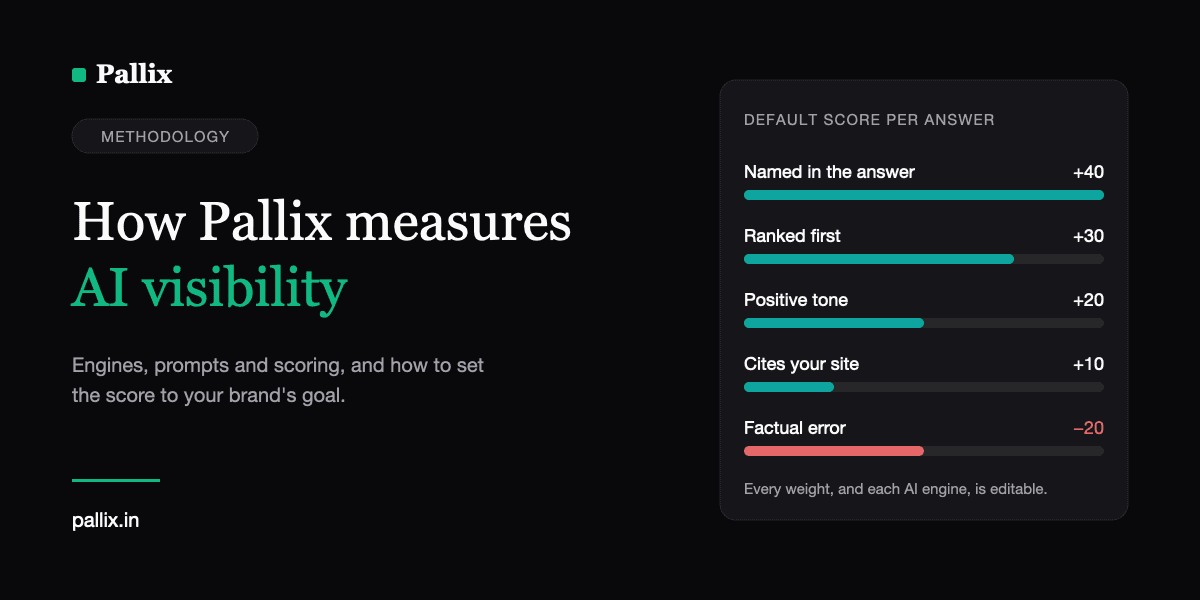
- Your visibility score is calculated around your brand's goal. By default, each answer earns up to 100 points: 40 for being named, 30 for ranking first, 20 for a positive tone and 10 for citing your site, minus 20 for a factual error.
- You can give any AI engine more weight in your score, such as counting ChatGPT twice if that is where your buyers ask. Admins can also change the score weights, the sentiment scale, the mention-rate rule and the share-of-voice pool.
- Every prompt shows its prompt volume, the Google search demand behind it, so you can focus on the questions buyers ask most.
- Prompts that contain your brand name are left out of scores by default, and metrics with too few answers behind them are hidden rather than guessed.
Which AI engines does Pallix check, and how are answers captured?
Pallix reads the answer a real buyer sees in each engine's consumer app, not a developer API that only approximates it. Each check is a fresh session with no personal chat history, so every run is asked under the same conditions and runs can be compared day to day.
| Engine | What is captured |
|---|---|
| ChatGPT | The answer shown at chatgpt.com, logged out, asked from your country. ChatGPT decides for itself whether to search the web, as it does for a real logged-out user. |
| Gemini | The answer shown in the gemini.google.com app, asked from your country. |
| Google AI Overviews | Google's AI-written answer for the query in your country, with its source links. |
| Perplexity | The answer shown at perplexity.ai, asked from your country. If the page cannot be read after several attempts, Pallix falls back to Perplexity's Sonar model with live web search. |
| Copilot | The Microsoft Copilot answer with web search on, using your country's time zone and locale. |
| Claude | The claude.ai answer in an incognito chat with web search on. |
| Grok | The Grok answer, asked from your country. |
Which engines run depends on your plan: Starter covers 3 engines, Growth any 5 of the 7 that you choose, and Agency / Enterprise all 7. Full details are on Pallix pricing.
How often are answers collected?
Scheduled checks run between 02:00 and 08:00 IST, and the dashboard updates as each day's answers are read. Growth refreshes every prompt daily, Starter twice a week, and Agency / Enterprise refreshes your top prompts daily and every prompt weekly.
Pallix asks each prompt once per engine per run day. If an engine fails or returns an empty page, the check is retried up to four times over the next 90 minutes, with longer waits when an engine is rate-limiting. An answer that still fails is left out of every calculation. It never counts as an answer that left you out.
Volume follows directly from your plan: prompts × engines × run days. Starter's 30 prompts on 3 engines, twice a week, come to about 180 answers a week. Growth's 50 prompts on 5 engines, daily, come to about 1,750.
Where are the questions asked from?
Each question is asked from inside the country you choose, through a connection located in that country, with that country's language settings. India, the United States, the United Kingdom, the UAE, Canada, Australia, Singapore, Ireland and New Zealand have fully configured market settings, and other countries can be selected too.
Perplexity and Claude have no location setting of their own for a logged-out session, so for those two engines Pallix adds the country to the question ("... in India") unless the question already names a place, a price in rupees, or is written in Hinglish.
You can also pin a prompt to a city. Pallix then asks every engine that exact question with the city added, such as "best sunscreen for oily skin in Mumbai", while your dashboard keeps showing the question as you typed it. Supported Indian cities include Mumbai, Delhi, Bengaluru, Hyderabad, Chennai, Pune, Kolkata, Ahmedabad, Gurugram and Jaipur.
Which questions are counted?
When you set up a brand, Pallix suggests 30 buying questions written the way a buyer would type them, built from your website, your category and your market. They are spread across five angles so the set is not a list of near-duplicates:
- Generic: "best protein powder in India"
- Concern: a problem the buyer wants solved, such as "protein powder that doesn't cause bloating"
- Feature: a specific attribute, such as "whey isolate with no added sugar"
- Audience: a specific buyer, such as "protein powder for women over 40"
- Pick: a direct choice, such as "which protein brand should I buy"
For India, at least two suggested prompts, and roughly one in six overall, are in Hinglish: Hindi and English typed in the Latin alphabet, such as "sabse accha protein powder kaunsa hai". Our Hindi vs English study shows why: the same question in a different language often returns different brands and different sources.
You can add, edit, pause and tag prompts at any time. Paused prompts are not asked and are not scored.
Prompt volume: which questions buyers actually ask
Not every question is worth the same. Pallix shows a prompt volume for each tracked prompt: an estimate of the real search demand behind it in your market. It takes the main phrase of the prompt ("sunscreen for oily skin" in "best sunscreen for oily skin under ₹500"), then looks up that phrase's monthly Google search volume and the Google autocomplete suggestions around it.
Each prompt gets a band, shown next to Google's rounded monthly figure:
| Band | Monthly Google searches for the main phrase |
|---|---|
| High | 1,000 or more |
| Medium | 100 to 999 |
| Low | 10 to 99 |
Prompt volume is used in three ways:
- Prioritise: sort your prompts by volume, so your team works first on the questions most buyers ask.
- Suggest: Google autocomplete shows the questions buyers type most in your category. Pallix suggests the popular ones your prompt set does not cover yet as new prompts to track.
- Group: prompts are grouped into topics, and a topic is only counted as having real demand when its phrases add up to at least 100 monthly searches.
Prompt volume measures demand for the short search phrase behind a prompt. It does not count how often people type the full question into an AI engine, because no AI engine publishes that data.
Branded prompts are left out by default
A prompt that contains your brand name, such as "is Brand X good for dry skin?", almost always returns Brand X. Counting it would inflate your score, so Pallix leaves these prompts out of your visibility score, mention rate, share of voice and daily metrics by default. You can include them under Settings → Scoring scope if you want to track how AI describes your brand when asked about it directly.
How is each answer read?
Every AI answer is read by a language model that returns a fixed set of fields, so every answer is read against the same rules. It is given your brand name, your website domain, the other names your brand goes by, your tracked competitors and your published product facts.
For each answer it records:
- Mentioned: whether the answer names your brand, under any of its tracked names.
- Position: the order in which your brand is first named among all the brands in the answer, where 1 means named first.
- Sentiment: whether the answer describes your brand positively, neutrally or negatively, with the reason.
- Aspects: the specific things the answer praises or criticises (price, texture, delivery, results), each with the supporting sentence from the answer.
- Competitors: every other brand the answer names, with its position and tone. Your tracked competitors are matched even when the answer uses a shorter or longer form of their name.
- Cited pages: every link the answer cites, and whether one of them is on your own domain.
- Factual error: whether the answer confuses your brand with another, credits your product to a competitor (or the reverse), or directly contradicts a known fact about you.
What counts as a mention
- A brand name that appears only inside a cited link or source label is not a mention. Perplexity and Google print source names inside the answer text, and Pallix ignores those.
- Your domain being cited does not, on its own, count as being named.
- A competitor name that never appears in the answer's prose is dropped.
- Marketplaces and retailers such as Amazon, Flipkart and Nykaa are tracked as sources, not as competitors.
- An answer where the engine only asked the buyer a clarifying question is not scored, because no recommendation was made.
What counts as a factual error
Pallix is deliberately strict here. An answer is flagged only for brand confusion, wrong attribution between brands, or a direct contradiction of a known fact about your brand. A price that differs from your site, a claim Pallix cannot verify, or a choice of source is not flagged. When the model is unsure, the answer is not flagged.
How are the scores calculated?
Every metric on your dashboard is calculated from the AI answers in the date range you pick (30 days by default), using only active prompts and, by default, leaving out branded prompts. Where a prompt was run more than once on a day, only that day's latest run counts.
The visibility score
Your visibility score is built around your brand's goal, and you can change every weight below to match it. By default, each answer earns up to 100 points:
| Component | Default points |
|---|---|
| Your brand is named | 40 |
| Position: named 1st / 2nd / 3rd or later | 30 / 20 / 10 |
| Tone: positive / neutral / negative | 20 / 10 / 0 |
| The answer cites a page on your domain | 10 |
| The answer contains a factual error about your brand | −20 |
The result is kept between 0 and 100. Two examples:
- ChatGPT names you second, describes you positively and cites your product page: 40 + 20 + 20 + 10 = 90.
- Gemini names you fifth, neutrally, without citing you: 40 + 10 + 10 = 60.
An answer that does not name you scores 0. A day's visibility score is the average across every answer collected that day, with each engine counted equally unless you change the engine weights. The large number on your Overview is the most recent run day's score, and the change beside it is the difference between the first and last day in your selected range.
Health bands: 65 and above is strong, 40 to 64 is average, below 40 needs work. Across the 23 Indian health and nutrition brands in our AI visibility study, the average was 42.5 out of 100.
The other AI visibility metrics
| Metric | What it tells you | Calculation |
|---|---|---|
| Mention rate | How often AI names you at all | Answers that name your brand ÷ all answers |
| Share of voice | Your share of all brand mentions in the answers | Your mentions ÷ (your mentions + competitor mentions) |
| Average position | Where you come in the list when AI names you | Mean first-mention position across answers that name you |
| Sentiment | Whether AI talks about you warmly or critically | Positive = 100, neutral = 50, negative = 0, averaged over answers that name you |
| Factual errors | How often AI gets your brand wrong | Count of flagged answers per day: 0 is strong, 1 to 2 average, 3 or more needs attention |
| Cited rate | How often AI uses your own pages as evidence | Answers citing a page on your domain ÷ all answers |
| Third-party support | Whether others vouch for you when AI names you | Mentions backed by a citation from a site you do not own ÷ all mentions |
Competitors are measured on the same prompts, engines and days as you, so every comparison is like for like.
Citations and source gaps
Every cited link is classified into one of 13 source types: your own site, a competitor's site, marketplace, YouTube, social media, community discussion, forum or Q&A, review platform, ranking or comparison page, news and media, reference, guide or article, and other. A site is labelled as yours only if it is on your own domain.
Source gaps are the sites AI keeps citing in your category where your competitors appear and you do not. Each gap gets an opportunity score out of 100 built from four things:
- How often AI cites that site in your category.
- How many prompts it shows up across.
- How far ahead your competitors are on that site.
- How winnable the site is. Listings, directories and marketplaces score highest because a brand can get onto them; review sites and communities follow; editorial, video and news sites are harder; a competitor's own site is never a target. Sites outside your market are marked down sharply.
The India AI Sourcing Index shows which sources this surfaces across Indian categories.
Query fanouts
Before answering, some engines run their own web searches. Pallix records those searches for each prompt and counts how many answers ran each one, so you see the exact phrases AI looks up in your category. ChatGPT reports these searches most reliably. Gemini and Google do not reveal theirs, so fanouts are not available for those engines.
How to set the scoring to your brand's goal
No single formula suits every brand. A brand that already dominates its category may care most about ranking first; a challenger may care most about being named at all; a brand with a reputation problem may want negative answers to hurt the score. Pallix lets you set the scoring to match.
Open Settings → Scoring (or click Edit scoring on the visibility score card). Admins can edit; other team members see the formula read-only.
| What you can change | Options | Default |
|---|---|---|
| Visibility recipe | Split 100 points between named, ranking, tone and cited (each at least 5). Ranking points split 3 : 2 : 1 across 1st, 2nd and 3rd or later. Neutral tone gets half the tone points. | 40 / 30 / 20 / 10 |
| Factual-error penalty | 0 to 40 points | 20 |
| Sentiment scale | Points for positive, neutral and negative answers. Presets: Balanced (100 / 50 / 0), Strict (100 / 25 / 0), Penalise negatives (100 / 50 / −100) | Balanced |
| Mention rate counts | Any mention, only answers where you are listed as an option, or only top-3 placements | Any mention |
| Share of voice pool | Every brand AI names, or only your tracked competitors | Every brand |
| Engine weights | 0 to 3 per engine in steps of 0.25, where 0 switches an engine off. At least one engine must stay on. | 1 for every engine |
Admins who want full control can switch to advanced mode and write their own visibility formula from the same inputs: named, position, positive, neutral or negative tone, domain cited and factual error.
Give more weight to the AI engines your buyers use
Engine weights are the quickest way to match your score to where your buyers ask. Set ChatGPT to 2 and its answers count twice as much as other engines in your visibility score, mention rate and share of voice. Set Perplexity to 0.5 and it counts half. Set an engine to 0 to leave it out of your scores altogether.
Three example setups
- "Being first is what sells." A category leader whose buyers pick the first brand AI names: named 30, ranking 45, tone 15, cited 10. Mention rate set to top 3.
- "Our buyers live on ChatGPT." A D2C brand whose referral data shows most AI traffic comes from ChatGPT: ChatGPT weight 2, Google AI Overviews 1.5, the rest 1.
- "We're fixing our reputation." A brand working through a product recall: sentiment preset Penalise negatives, factual-error penalty 40.
What a scoring change affects
- Your Overview score and trend are recalculated from the AI answers for the whole date range you are viewing, so history stays comparable under the new formula.
- Score alerts use the same customised score.
- The Competitors, Prompts and citation pages keep the Pallix default formula, so leaderboards stay comparable across brands.
- An agency can set one formula for all its client brands, and each brand can override it. The order is: brand setting, then agency or account setting, then the Pallix default.
How many answers does a score need?
AI engines can name different brands when the same question is asked twice, so a score is only as precise as the number of answers behind it. At a true mention rate of 50%, the 95% range is about ±18 points with 30 answers, ±7 points with 180 answers (a Starter week) and ±2 points with 1,750 answers (a Growth week).
Pallix hides a metric rather than show a number that noise could produce:
- Sentiment needs at least 10 answers that name you.
- Average position needs at least 10 answers that name you before it is ranked.
- Citation rates need at least 8 answers and 8 citations.
- Category rankings of competitors need at least 30 answers.
- A low-data badge appears on the score card when fewer than 15 prompts are active.
What the "what changed" panel reports
The what-changed panel compares the last 7 days with the 7 before, and the last 14 with the 14 before. A move counts as real only when it is larger than twice the standard error of the difference between the two periods (and never less than 1 point), with at least 2 run days in each period. Smaller moves are shown as flat, because they are normal run-to-run variation.
Alerts work the same way: you set a rule on visibility score, mention rate or share of voice, such as "falls below 40" or "drops by 5 points week on week". Pallix checks it every morning and emails you once when the rule is crossed.
How are fixes ranked and measured?
Pallix turns the gaps it finds into a ranked list of fixes: correct a fact AI gets wrong, update a page, publish a comparison, get onto a site AI cites, improve a marketplace listing, or fix a technical block. Each fix links to the answers and sources behind it, and where a fix needs content, Pallix drafts it.
Fixes are ranked by four things: how many tracked answers the gap affects, how far behind your competitors you are on it, how easy the change is, and whether it edits a page you already have (usually faster than writing a new one). Corrections of factual errors always come first.
When you mark a fix done, Pallix waits until it can see the change live, then compares how often you are named in the affected answers against the 28 days before. It keeps collecting until it has 80 answers or 56 days have passed. A fix counts as working only when the lift is larger than normal variation would explain and larger than the change on the same prompts in answers that do not touch the fixed page. With fewer than 20 answers, Pallix says it is too early to tell.
Where can I check Pallix research?
Pallix publishes the studies behind its methods:
- AI visibility of 23 Indian health and nutrition brands: 51.6% of traced citations came from competitor websites and 5.8% from the brand's own site. Covered in afaqs!, IndianTelevision.com and Campaign India.
- Hindi vs English in AI answers: what changed when 690 buyer prompts were asked in both languages.
- India AI Sourcing Index: which publishers, marketplaces and communities AI cites for Indian categories.
To see these numbers for your own brand, run the free AI visibility audit: 20 prompts on 3 AI engines, no signup. For what each part of the dashboard does, see Pallix capabilities. For why a rival gets named instead of you, read why competitors show up in ChatGPT.
Frequently asked questions
Does Pallix use the ChatGPT app or the API?
The app. Pallix records the answer shown at chatgpt.com, logged out, asked from inside your chosen country. Gemini, Copilot, Claude, Grok and Perplexity are read from their consumer apps the same way. The only API in the capture path is Perplexity's Sonar model, used as a backup when the Perplexity page cannot be read.
How is the Pallix visibility score calculated?
Your visibility score is calculated around your brand's goal, and you can change its weights. By default, each answer earns up to 100 points: 40 for naming your brand, up to 30 for its position (30 first, 20 second, 10 third or later), up to 20 for tone (20 positive, 10 neutral) and 10 if it cites your site, minus 20 for a factual error. The day's score is the average across all answers that day.
Can I change how Pallix scores visibility?
Yes. Pallix lets you set the score to your brand's goal. Under Settings → Scoring, admins can give any AI engine more weight and change the four visibility weights, the factual-error penalty, the sentiment scale, and how mention rate and share of voice are counted. Your Overview score and history are recalculated with the new formula.
Does Pallix count prompts that include my brand name?
Not by default. Asking about a brand by name almost always returns that name, so branded prompts are left out of your visibility score, mention rate and share of voice. You can include them under Settings → Scoring scope.
How accurate are Pallix's AI visibility metrics?
A metric is as precise as the number of answers behind it. Pallix hides sentiment, average position and citation rates until enough answers exist, and only reports a change when it is larger than normal run-to-run variation. Every answer is stored in full, so you can open any answer and check how it was scored.