AI Visibility
The Best AI Visibility Tool for a New Brand in 2026 (and What to Do in Your First 30 Days)
What a new brand should track, which tool fits a small budget, and the 30-day plan we'd run first. Based on our own data from 1,352 AI answers and 29 tracked brands.
Contents(10 sections)
The short answer
The best AI visibility tool for a new brand in 2026 is the one that tells you which pages AI reads instead of yours, and costs little enough to run for three months while you fix that.
- Pallix: best for new Indian brands that want the gaps and the fixes, from ₹2,249/mo.
- Otterly.AI: best low-cost tracker for a global brand.
- AthenaHQ: best free plan to see your starting point.
- Peec AI: best for a clean daily number once you're named.
- Semrush AI Visibility Toolkit: best if you already pay for Semrush.
- HubSpot AEO: best cheap start if you already use HubSpot, $50/mo.
Profound and other enterprise platforms come up often in AI answers to this question. They're built for large teams, so we left them out of the main list.
A quick, honest note: we built Pallix. We'll show you our numbers, including the ones where AI doesn't name us.
What a new brand looks like to AI
We track AI answers for 29 brands, most of them Indian. In the last 30 days that was 54,565 answers to the questions their buyers ask.
- The median brand was named in 34.5% of answers about its own category.
- Five of the 29 brands were named in fewer than 1 in 10 answers. That's what "new" looks like to AI, even for brands that have been selling for years.
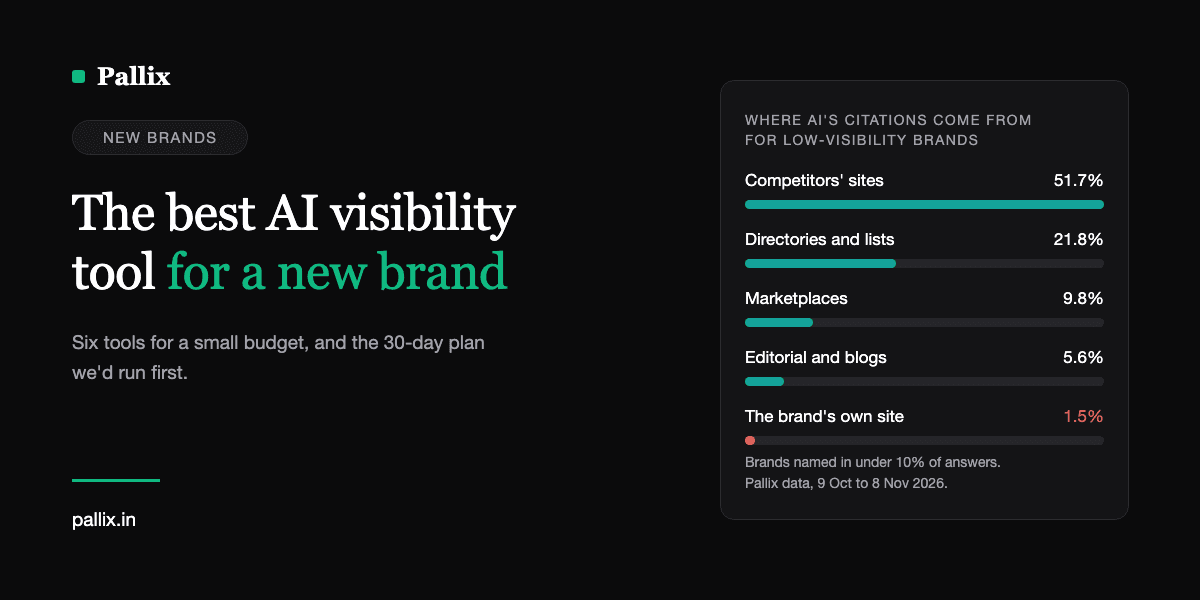
For those five low-visibility brands, AI built its answers from other people's pages:
| Where AI's citations came from | Low-visibility brands (under 10%) | Everyone else |
|---|---|---|
| Competitors' own websites | 51.7% | 44.4% |
| Directories and "best of" aggregators | 21.8% | 18.3% |
| Marketplaces | 9.8% | 12.0% |
| Editorial and blogs | 5.6% | 6.8% |
| The brand's own website | 1.5% | 5.1% |
Source: Pallix, 22,758 and 361,128 citations, 9 Oct to 8 Nov 2026.
AI cited the low-visibility brand's own site in 6.6% of answers, against 21.2% for the rest.
So the first job for a new brand is to find the competitor pages, directories and comparison articles AI already reads, and get onto them. A visibility score near zero won't tell you much yet.
What a new brand needs from an AI visibility tool
A large brand buys these tools to defend a share. A new brand buys one to get its first mentions. That changes what matters:
- Source lists, not trend lines. A chart of your 3% share isn't useful yet. A list of the 20 pages AI cites for your prompts is.
- Prompts with real demand. Track the questions buyers actually ask. A tool that shows search volume per prompt saves you from tracking questions nobody types.
- A price you can hold for 90 days. Getting named takes weeks of listings and content. You need to measure before, during and after.
- The engines your buyers use. For most brands that's ChatGPT, Gemini and Google AI Overviews first. You can add more later.
- Help with the fix. Ideally the tool tells you what to publish or where to pitch, so a small team can act on it.
We asked AI which tool a new brand should use, 1,352 times
We track three versions of this question across seven AI engines: "Best AI visibility tool for a new brand", "Best tool that can make our brand visible on AI?" and "Best AI visibility improvement app?". From 11 August to 8 November 2026, that gave us 1,352 answers. Here's how often each tool was named:
| Tool | Share of answers that named it |
|---|---|
| Semrush | 74% |
| Otterly.AI | 74% |
| Profound | 68% |
| Peec AI | 59% |
| Ahrefs | 45% |
| Scrunch | 14% |
| AthenaHQ | 13% |
| Writesonic | 11% |
| Frase | 10% |
| Pallix | 5% |
Source: Pallix tracking, 1,352 answers from ChatGPT, Gemini, Google AI Overviews, Perplexity, Copilot, Claude and Grok. Counts merge spelling variants of the same tool (for example "Otterly" and "Otterly.AI").
Two things stand out. First, AI defaults to the best-known names, including enterprise platforms that most new brands can't afford. Second, the pages AI cited most for these questions were large roundups: Zapier's, Semrush's, Ahrefs' and Alhena's lists of AI visibility tools. If a tool isn't on those lists, AI rarely names it. That includes us, for now.
The 6 tools for a new brand
| Tool | Best for | Starting price | AI engines on entry plan | Free option |
|---|---|---|---|---|
| Pallix | New Indian brands that want the fixes | ₹2,249/mo (about $25) | ChatGPT, Gemini, AI Overviews | Free audit, 7-day trial |
| Otterly.AI | Low-cost tracking, global brands | $29/mo | ChatGPT, AI Overviews, Perplexity, Copilot | Free trial |
| AthenaHQ | Seeing your starting point for free | Free, then $295/mo | 5 free, 11 paid | Free tier |
| Peec AI | A daily number once you're named | $95/mo | Pick 3 | Free trial |
| Semrush AI Visibility Toolkit | Teams already on Semrush | $99/mo | ChatGPT, AI Mode | No trial on the toolkit |
| HubSpot AEO (beta) | Founders on HubSpot | $50/mo | ChatGPT, Gemini, Perplexity | Free trial, 25 prompts |
Prices as listed on vendor pages on 8 November 2026. The rupee conversion is approximate. Pallix prices exclude 18% GST.
1. Pallix: best for new Indian brands
Pallix shows the pages AI reads for each of your buyers' questions, the sites that cite your rivals but not you, and a weekly ranked list of fixes with the content drafted. Prompts are asked from inside India, by city, in English and Hinglish.
Starter is ₹2,499/mo, or ₹2,249/mo billed yearly, for 30 prompts on ChatGPT, Gemini and Google AI Overviews, twice a week. It also shows real search volume per prompt, so you track the questions buyers actually type. If your team is small, Managed AEO Services (₹9,999/mo, one-month pilot at ₹4,999) has our team write the fixes for you.
Where it falls short: 3 engines on Starter, and Pallix is built India-first.
2. Otterly.AI: best low-cost tracker for a global brand
Otterly.AI starts at $29/mo and tracks ChatGPT, Google AI Overviews, Perplexity and Copilot on every paid plan. It adds content audits, recommendations and citation analysis.
Where it falls short: Gemini and AI Mode are paid add-ons, and there's no India location.
3. AthenaHQ: best free way to see your starting point
AthenaHQ's free Essential tier covers ChatGPT, Perplexity, AI Overviews, Gemini and Copilot. Use it to measure your baseline before you spend anything.
Where it falls short: the next plan up is $295/mo, a big step for a new brand.
4. Peec AI: best once you're getting named
Peec AI starts at $95/mo and lets you pick 3 engines. Its recommended actions and source analytics are useful once you have mentions to grow.
Where it falls short: at near-zero visibility, a daily score has little to show you yet.
5. Semrush AI Visibility Toolkit: best if you already pay for Semrush
Semrush lists the toolkit at $99/mo in its knowledge base, and its AI search site audit checks for crawler blocks. India is listed as a country for its visibility and prompt research reports.
Where it falls short: prompt tracking covers only ChatGPT and AI Mode, and there's no trial on the toolkit itself.
6. HubSpot AEO: best cheap start for HubSpot users
HubSpot AEO is $50/mo, or $45/mo billed annually, for ChatGPT, Gemini and Perplexity. It's still in beta and has a free trial with 25 prompts.
Where it falls short: no Google AI Overviews, and only 3 engines.
Why not Profound?
AI named Profound in 68% of these answers. It's a strong tool for enterprise teams, but it lists only a 7-day trial and custom pricing, which doesn't fit most new brands.
Your first 30 days
This is the plan we'd run for any new brand, whatever tool you pick.
Week 1: set a baseline. Pick 20 to 30 questions your buyers ask, in the words they use. Include "best [product] for [use]" questions and comparisons with your top rivals. Run them on ChatGPT, Gemini and Google AI Overviews.
Week 2: list the pages AI reads. For every question, note the pages AI cites. Group them: competitor sites, directories, marketplaces, articles and reviews. In our data, those first three groups make up over 80% of citations for low-visibility brands.
Week 3: get onto those pages. List your brand on the directories and marketplaces that keep coming up. Pitch the writers of the comparison articles AI cites. Answer the Reddit and Quora threads it reads.
Week 4: fix your own pages. Add a clear one-line answer to "what is [brand] and who is it for" on your homepage. Publish one honest comparison page against the rival AI names most. Then measure again.
Expect the first changes in weeks, not days. AI engines refresh what they read at different speeds.
Where tools stop being enough
No tool will get you named on its own. The tool finds the gap. Your team, or an agency, still has to earn the listing, write the page and pitch the article.
If your team can't do that work every week, pick a tool or plan that includes it, or budget for help.
Frequently asked questions
What is the best AI visibility tool for a new brand?
For a new Indian brand, Pallix: it shows which pages AI reads for your category and drafts the fixes, from ₹2,249 a month. For a global brand on a small budget, Otterly.AI.
How long does it take a new brand to show up in AI answers?
Usually weeks to a few months. It depends on how fast you get listed on the pages AI already cites for your category.
Do I need to track every AI engine?
No. Start with ChatGPT, Gemini and Google AI Overviews, where most buyers ask. Add Perplexity, Copilot, Claude or Grok when you have a reason to.
Is there a free way to check AI visibility for a new brand?
Yes. AthenaHQ has a free tier covering 5 AI engines, HubSpot AEO has a free trial with 25 prompts, and Pallix runs a free audit.
Why doesn't AI mention my brand?
Most often because the pages AI reads for your category don't mention you. For low-visibility brands in our data, only 1.5% of citations went to the brand's own site.
How we researched this
AI answers. Pallix tracks three "which tool for a new brand" questions on seven AI engines. The 1,352 answers ran from 11 August to 8 November 2026.
Brand data. The 29-brand figures cover every brand Pallix tracked with at least 200 answers between 9 October and 8 November 2026. We report them as totals only, with no brand named.
Vendor facts. Prices, engines and plans come only from each vendor's own pages, checked on 8 November 2026. Where a page didn't state something, we left it out.
Vendor pages we checked: Pallix, Otterly.AI, AthenaHQ, Peec AI, Semrush toolkit, HubSpot AEO and Profound.
Prices change often, so check each vendor's page before you buy.
Want more?
- Best AEO tools in 2026
- Why competitors show up in ChatGPT and you don't
- How ChatGPT decides which brands to recommend
To see your own starting point, run the free Pallix audit.